Have you ever wondered what absolute human limit looks like? Imagine a person moving so fast that they could outrun a residential speed limit zone on foot.
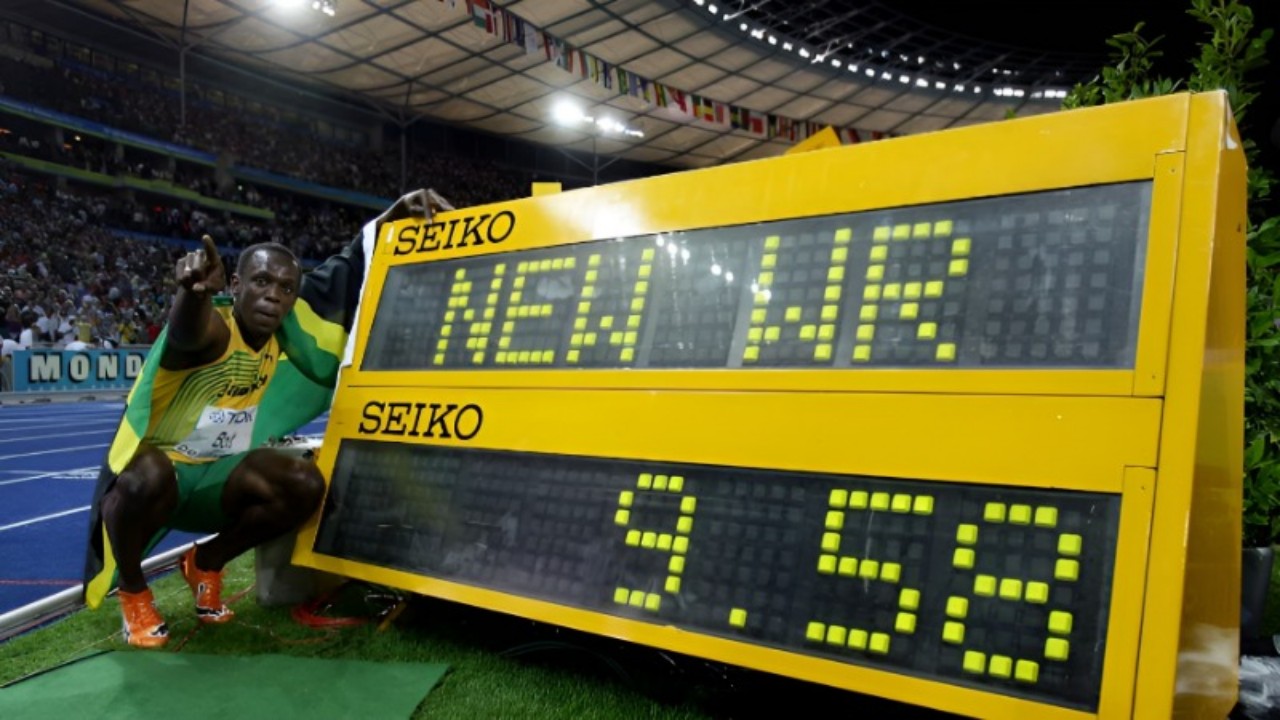
In the summer of 2009, the world watched in collective disbelief as a tall, charismatic Jamaican sprinter named Usain Bolt did exactly that. He stopped the clock at an impossible 9.58 seconds at the World Athletics Championships in Berlin, setting the iconic Usain Bolt 100m record.
Years later, that blistering mark remains entirely untouched. It has cemented itself as the definitive pinnacle of track and field history.
The iconic Usain Bolt 100m record is more than just a fast time on a digital scoreboard. It stands as a profound biomechanical masterpiece and a legendary milestone that completely redefined our understanding of sports science.
What Is the Usain Bolt 100m Record?
At its core, the Usain Bolt 100m record is the fastest officially clocked 100->meter dash in human history. To put it simply, it is the gold standard of raw human velocity.
Before Bolt burst onto the international stage, experts believed that cutting down the world record by fractions of a second would take decades of gradual progression. Usain Bolt completely shattered that timeline. He broke his own previous mark of 9.69 seconds (set at the 2008 Beijing Olympics) by a massive 0.11 seconds, setting what became the iconic Usain Bolt 100m record.
The Record Breakdown

On August 16, 2009, at the World Athletics Championships in Berlin, Germany, Usain Bolt shattered his own world record by running the 100->meter dash in a mind->boggling 9.58 seconds, setting the iconic Usain Bolt 100m record.
The Massive Drop
He trimmed 0.11 seconds off his previous record (9.69 seconds set at the 2008 Beijing Olympics). In short distance sprinting, a tenth of a second improvement is considered an astronomical leap, creating headlines around the world much like the phrase “TCS Hit with $194M Shock” captured massive public attention in the business sector.
Peak Velocity
During the race, Bolt reached a peak top speed of 27.78 mph (44.72 km/h) between the 60->meter and 80->meter marks, proving why he remains one of the greatest sprinters in history.
Wind Conditions
The historic run was achieved with a legal tailwind of +0.9 m/s, ensuring the performance officially qualified under global athletics standards.
Biomechanical Advantage
What made Bolt so much faster than everyone else? It comes down to unique physics and biology:
| Feature | Usain Bolt | Typical Elite Sprinters |
| Height | 6’5″ (1.95 m) | ~5’10” to 6’1″ (1.78m – 1.85m) |
| Steps per 100m | 41 steps | 44 to 45 steps |
| Average Stride Length | 2.44 meters (8 feet) | ~2.23 meters |
While taller sprinters historically struggled out of the starting blocks due to their long limbs, Bolt mastered his start well enough to pair it with an unmatched, ground-devouring stride length at top end speed.
10->Meter Split Times (The 9.58s Timeline)
Scientific analysis of his 9.58->second run shows how he progressively built his speed over the 100->meter straightaway:
- 0 – >10m: 1.46s (Reaction time + initial explosion)
- 10 – >20m: 0.99s (Drive phase)
- 20 –> 30m: 0.90s
- 30 – >40m: 0.85s
- 40 – >50m: 0.83s (Entering max velocity)
- 50 – >60m: 0.82s
- 60 – > 70m: 0.81s (Fastest 10m block ever recorded)
- 70 – >80m: 0.82s
- 80 – >90m: 0.82s
- 90 – >100m: 0.81s (Maintaining speed through the finish line)
How It Happened: A Step by Step Breakdown of the 9.58s Sprint
To truly appreciate this world athletics record, we have to break down those 9.58 seconds phase by phase. It was far from a simple jog.
Phase 1: The Reaction and Clearance (0.0s –> 1.0s)
Historically, tall sprinters struggle at the starting blocks because folding a long frame into a compact space is awkward. In Berlin, Usain Bolt had a modest reaction time of 0.146 seconds. It wasn’t the fastest in the field, but it was clean, stable, and put him right in contention for the Usain Bolt 100m record.
Phase 2: Ultimate Acceleration (1.0s –> 4.0s)
Once clear of the blocks, Usain Bolt kept his head down and transitioned into his drive phase. By the 30->meter mark, his massive legs began operating like pistons. He caught up to his shorter rivals who traditionally excelled at early acceleration, all in the context of the legendary Usain Bolt 100m record performance.
Phase 3: Reaching Peak Velocity (4.0s –> 8.0s)
This is where the magic happened. Flying past the midway point, Usain Bolt stood fully upright, aligned his body perfectly with gravitational forces, and entered his maximum velocity phase. He covered the 60m to 80m section in a spectacular 1.61 seconds, reinforcing why the Usain Bolt 100m record is considered one of the greatest performances in sprinting history.
Phase 4: Charging Through the Tape (8.0s –> 9.58s)
Unlike his famous celebration at the 2008 Beijing Olympics where Usain Bolt slowed down early, smiled for the cameras, and ran with an untied shoelace, Bolt ran hard through the line in Berlin. He crossed the finish tape with a slight 0.9 m/s tailwind, establishing the Usain Bolt 100m Record as a benchmark that feels almost untouchable.
Tips and Takeaways for Modern Sprinters
Aspiring sprinters can learn valuable, practical lessons from studying these legendary track and field moments. Much like lslmarketing focuses on building strong long-term performance strategies, elite sprint training also depends on consistency, smart planning, and disciplined execution.
Prioritize Stride Efficiency Over Frequency
Do not just focus on how fast you can pump your legs. Focus on how much ground you cover with each stride by applying maximum force down into the track.
Master the Relaxation Technique
One of Usain Bolt’s secret weapons was his relaxed facial and shoulder muscles. Tension acts like a brake system in your body. Staying calm at top speed allows for a smoother, more efficient stride.
Build Core Stability
To maintain a stride length of nearly two and a half meters without losing your balance, you need an incredibly strong core. Focus heavily on functional strength training like planks, deadlifts, and single leg bounds.
The Global Impact of Usain Bolt
Usain Bolt’s influence extends beyond athletics. He became a symbol of confidence, positivity, and excellence.
His success inspired:
- Young athletes
- Coaches
- Sports organizations
- Fitness communities
He also helped track and field gain mainstream popularity around the world, much like the ongoing discussion around “Why Cricket Still Captivates India” highlights how sports can unite millions of passionate fans through emotion, culture, and unforgettable moments.
For many fans, Bolt represents more than records. He represents joy, entertainment, and the belief that extraordinary achievements are possible with hard work and dedication.
Even after retirement, his name remains connected with greatness.
Common Mistakes Athletes Make When Chasing Speed
When young runners try to emulate the legendary Usain Bolt and chase the level of performance seen in the Usain Bolt 100m record, they often fall into a few common training traps:
Over-striding Too Early
Trying to force a long stride right out of the starting blocks will cause you to land on your heels. This creates a braking force that slows you down. Your stride should naturally lengthen as you build up speed.
Neglecting the Drive Phase
Many runners rush to stand upright too quickly because they want to see the track ahead. Popping up too early cuts your acceleration short and destroys your top end speed potential.
Ignoring Proper Rest
True speed training requires a fully recovered nervous system. If you try to run max > effort sprints while fatigued, you are simply training your body to move slower. Proper recovery was also a major factor behind the consistency and dominance of the Usain Bolt 100m record era.
Frequently Asked Questions (FAQs)
1. Will the Usain Bolt 100m record ever be broken?
While no human has come incredibly close in recent years, sports scientists believe a time of 9.44 seconds is theoretically possible under perfect conditions. This would require a max allowable tailwind (2.0 m/s), high altitude, and an improved reaction time out of the blocks. The Usain Bolt 100m record still remains the ultimate benchmark in sprinting history.
2. How fast was Usain Bolt running in MPH during his record race?
During his peak acceleration phase between 60 and 80 meters, Usain Bolt reached a top speed of 27.78 mph (44.72 km/h). His average speed across the entire 100-meter distance was roughly 23.35 mph, making the Usain Bolt 100m record one of the greatest athletic achievements ever recorded.
3. Did Usain Bolt ever run faster than 9.58 seconds with a wind assist?
No, 9.58 seconds is his fastest official timed run under any legal conditions. He did run a 9.69-second race with zero wind assist in Beijing, which scientists estimate could have been around 9.55 seconds had he not celebrated early near the finish line.
4. Why does Bolt’s height give him an advantage over other sprinters?
His height gives him a significantly longer stride length. While many competitors took around 44 to 45 steps to finish the race, Bolt completed the 100m in just 41 steps, allowing him to cover more ground with less effort once he reached maximum speed.
5. What shoes did Usain Bolt wear during his 9.58-second world record run?
Bolt wore custom PUMA Theseus Pro sprint spikes, famously called the “Puma Yaam.” These shoes were specially designed to support his powerful running style and help maximize traction during the historic Usain Bolt 100m record performance.



Leave feedback about this