
Introduction
The idea of antigravity has fascinated scientists, inventors, and science fiction fans for decades. Imagine cars floating above roads, spacecraft traveling across galaxies at incredible speed, or buildings designed with gravity defying concepts that seem impossible today. While true antigravity technology is still being researched, modern science has already made surprising discoveries related to zero gravity science and futuristic space propulsion.
Many people think antigravity only belongs in movies, but researchers around the world are exploring how gravity works and whether it can someday be controlled. From magnetic levitation trains to advanced NASA experiments, the dream of reducing or overcoming gravity continues to inspire innovation.
In this article, you will discover the hidden science behind antigravity, how it may shape the future, its potential benefits, common misconceptions, and practical insights that make this topic exciting for everyone.
What Is Antigravity?
Antigravity refers to the theoretical ability to counteract or reduce the effects of gravity. In simple words, it is the concept of making objects float or move without the normal pull of Earth’s gravity.
Gravity is the natural force that pulls everything toward the center of the Earth. Scientists like Isaac Newton and Albert Einstein helped explain how gravity works through major scientific discoveries.When people think of floating, they often picture true antigravity a magical field that completely neutralizes gravitational pull. In reality, scientists cannot “turn off” gravity.
The Science Behind Antigravity
Gravity is created by mass. Large objects like planets and stars produce strong gravitational fields. Scientists believe that if gravity can be manipulated, future transportation and space exploration could completely change.
Zero Gravity Science Explained
Zero gravity science studies environments where objects appear weightless. Astronauts aboard the International Space Station experience this condition daily. space, astronauts are constantly falling around Earth while moving at high speed. This creates the sensation of floating.
Key Areas of Research
- Electromagnetic field manipulation
- Quantum physics
- Space time distortion
- High energy propulsion systems
- Superconductors
Some researchers believe future discoveries in these fields may eventually support antigravity technology.
Key Features and Benefits of Antigravity Technology
Developing functional levitation methods isn’t just about showing off cool science tricks. This branch of engineering offers massive practical advantages for the future of transportation, manufacturing, and science.
Eliminating Mechanical Friction
The biggest enemy of speed and efficiency is friction. When two surfaces touch, energy is lost as heat, and parts wear down. Levitation technology completely removes contact between moving parts. This allows vehicles to travel at incredible speeds while using a fraction of the energy.
Ultra Clean Manufacturing
In industries like semiconductor manufacturing or pharmaceuticals, even a microscopic speck of dust can ruin a product. Because levitating objects don’t touch mechanical conveyor belts or robotic arms, they don’t generate friction dust. This makes the entire assembly process perfectly sterile.
Revolutionary Transportation
By mastering zero gravity science on a terrestrial scale, we can completely redesign how we move. Levitating transport systems require less maintenance because there are no wheels, axles, or bearings to wear out, resulting in safer, faster, and quieter public transit.
Real Life Example
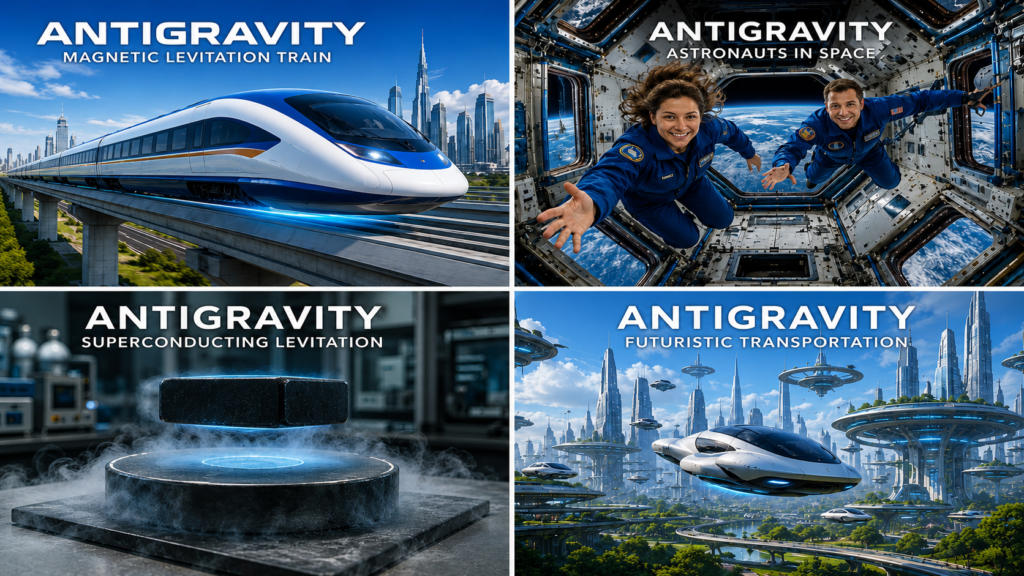
What Are Maglev Trains?
Maglev stands for “magnetic levitation.” These trains float slightly above the tracks using powerful magnets instead of wheels.Because the train does not touch the rails, friction becomes extremely low. This allows the train to travel at very high speeds smoothly and quietly.
Why Astronauts Float
Astronauts are not escaping gravity completely. Earth’s gravity still affects them strongly.The station continuously falls around Earth while moving at extremely high speed. This creates microgravity, making astronauts appear weightless.
NASA’s Advanced Propulsion Research
has inspired growing discussions around futuristic innovation after headlines like “TCS Launches New Company with Rs 88 Billion” gained attention in the technology world. Similarly, NASA has been actively researching advanced propulsion systems that could shape the future of antigravity technology and deep space exploration.
How Antigravity Technology Work
Although true antigravity has not yet been fully achieved, researchers continue exploring different theories and experimental systems.
Step 1: Understanding Gravity Fields
Scientists first study how gravity interacts with matter, energy, and space time.Einstein’s theory of relativity explains that massive objects bend space around them.
Step 2: Exploring Electromagnetic Forces
Electromagnetic forces can sometimes oppose gravity under controlled conditions.
Example
Magnetic levitation trains use strong magnets to lift and move trains without direct contact with tracks.This reduces friction dramatically and allows higher speeds.
Step 3: Studying Quantum Physics
Quantum physics explores how tiny particles behave at microscopic levels.Some theories suggest unknown particles or energy fields could someday help scientists manipulate gravity itself.While this remains highly experimental, it continues to inspire futuristic space propulsion research.
Step 4: Developing Advanced Propulsion Systems
Organizations like NASA and are researching technologies that could support long-distance space travel and advanced propulsion systems. Scientists hope these innovations may eventually reduce the limitations caused by gravity and improve futuristic transportation methods. As interest in space science grows online, technology and innovation platforms such as lslmarketing are also helping audiences stay informed about emerging trends in science, digital technology, and future focused industries.
Tips and Best Practices for Understanding Antigravity
Building systems that defy gravity requires extreme precision. Whether engineers are designing a mass transit track or a small lab experiment, several best practices must be followed.
- Prioritize Stability Over Lift: It is relatively easy to push an object upward into the air. The real challenge is keeping it there without it flipping over or sliding away. Systems must include active feedback loops to adjust forces in real time.
- Manage Thermal Energy: Superconductors require extreme cold, while powerful electromagnets generate massive amounts of heat. Effective cooling infrastructure is non negotiable for long-term system health.
- Optimize Energy Efficiency: Generating the forces required to lift heavy objects demands a lot of power. Designers should focus on permanent magnet arrays, like Halbach arrays, to maximize magnetic force without draining extra electricity.
Why Antigravity Fascinates Humanity
Antigravity has fascinated humanity for generations because it represents freedom from one of nature’s most powerful forces. Gravity affects every part of human life, from how we walk and move to how planets orbit stars. The idea of overcoming gravity feels exciting, mysterious, and almost magical. For many people, antigravity symbolizes the future of unlimited possibilities, advanced technology, and human progress.
The Dream of Flying Freely
One of the biggest reasons people are fascinated by antigravity is the dream of effortless flight. Humans have always imagined floating cars, flying cities, and vehicles that move smoothly through the sky without roads or runways.
Long before airplanes existed, ancient stories and science fiction novels described machines capable of defying gravity. Today, modern innovations like drones and magnetic levitation trains show that some gravity defying concepts are slowly becoming reality.
Connection to Space Exploration
Antigravity is also closely connected to humanity’s desire to explore space. Earth’s gravity is one of the biggest challenges in space travel because rockets need enormous amounts of energy to escape the planet.
Organizations like NASA and private aerospace companies continue researching futuristic space propulsion systems to make long distance missions more practical.
- Transportation efficiency
- Space colonization
- Environmental sustainability
- Energy conservation
The Ultimate Dream: Real Antigravity and Space Travel
According to Einstein’s Theory of General Relativity, gravity is the bending of spacetime caused by mass. To reverse that bend and create a repulsive gravity field, you would need matter with negative mass. While negative mass exists as a mathematical concept in some theoretical models, no such material has ever been discovered in nature.
Regular Mass (Earth)   --> Bends spacetime downward --> Pulls things in
Negative Mass (Exotic) --> Bends spacetime upward   --> Pushes things away
Until that day comes, our current levitation technology remains a brilliant demonstration of human ingenuity, showing that we do not need to break the laws of physics to achieve what once seemed impossible. Even complex ideas like Anomalous Asymmetry and Sunward Activity are studied in advanced physics and space science research to better understand cosmic behavior and energy patterns. From magnetic levitation systems to zero gravity science experiments, these innovations continue to inspire progress in antigravity technology, futuristic space propulsion, and other gravity defying concepts that may shape the future of transportation and space exploration.
FAQs About Antigravity
1. Is antigravity real?
True antigravity has not been fully achieved yet. However, scientists are researching ways to counter gravity using magnetic fields, advanced propulsion systems, and quantum physics experiments.
2. How do Maglev trains relate to antigravity?
Maglev trains use strong magnetic fields to lift trains slightly above tracks. This reduces friction and creates a floating effect, though it is not true gravity cancellation.
3. Can antigravity help space travel?
Yes, future antigravity technology could potentially improve futuristic space propulsion, reduce fuel usage, and make deep-space missions faster and more efficient.
4. What is zero gravity science?
Zero gravity science studies environments where objects appear weightless, such as inside spacecraft orbiting Earth. It helps scientists understand motion, health, and physics in space.
5. Will humans ever create real antigravity machines?
Scientists do not yet know if complete gravity control is possible. However, ongoing research in physics, magnetism, and space exploration continues to move closer to new discoveries.



Leave feedback about this