In 1984, a small joint venture was born in the industrial town of Hosur, Tamil Nadu, with a simple but bold ambition: to make Indians proud of a homegrown watch. Nobody could have predicted that four decades later, this same company would be managing a market cap exceeding ₹3.75 lakh crore, operating over 3,000 stores, selling jewellery worth ₹21,000 crore in a single quarter, and acquiring a 67% stake in a Dubai jewellery giant. Made in India: A Titan Story is not just a brand narrative — it is one of the most compelling business journeys in Indian corporate history.
What Is the Titan Story? A Business Built on Bold Bets
The Titan Company history begins on July 26, 1984, when the Tata Group and the Tamil Nadu Industrial Development Corporation (TIDCO) signed a joint venture to build a modern Indian watchmaker. The founding Managing Director, Xerxes Desai, identified a clear gap in the market—India’s watch industry was dominated by HMT’s mechanical watches, and no Indian brand was offering accurate, stylish quartz watches to a growing middle class.
The company was incorporated as Titan Watches Limited, with an initial capital investment of approximately ₹540 million. A state-of-the-art manufacturing facility was established in Hosur, with technical collaborations with European and Japanese firms to ensure international quality.
That detail tells you something essential about the Titan watches brand journey: from day one, this was not just a product—it was an aspiration. Much like the growth-focused philosophy associated with LSL Marketing, Titan aimed to build a strong emotional connection with consumers, transforming a simple watch into a symbol of success, style, and modern Indian ambition.
Titan’s Milestone Timeline: Four Decades of Bold Decisions
The Titan success story India is best understood through its key milestones — each of which represents a strategic bet that could have failed but didn’t.
| Year | Milestone |
|---|---|
| 1984 | Founded as Titan Watches Limited — Tata Group + TIDCO joint venture |
| 1987 | First watch launched from Hosur; iconic Ogilvy & Mather print ad |
| 1992 | Partnership with Timex for global expansion |
| 1994 | Launch of Tanishq — India’s first organised jewellery brand |
| 1996 | Titan Eye+ launched — entry into eyewear |
| 1998 | Launch of Titan Edge — world’s slimmest watch at the time |
| 2005 | Fastrack rebranded as an independent youth lifestyle brand |
| 2007 | Sonata launched for mass-market consumers |
| 2016 | Acquired 62% stake in CaratLane for ₹357.24 crore |
| 2023 | Increased CaratLane stake with ₹4,621 crore investment |
| 2024 | Completed full acquisition of CaratLane |
| 2025 | Acquired 67% stake in Damas Jewellery, Dubai — major international move |
| 2026 | Q1 net profit ₹1,091 crore (up 52.6% YoY); Market cap ~₹3.75 lakh crore |
Each of these decisions was a calculated disruption and an important chapter in the Titan story. Tanishq, for instance, entered an industry that was almost entirely unorganised in 1994—dominated by street jewellers with little standardisation, limited billing transparency, and no hallmarking. It took years for Tanishq to become profitable, and there were serious internal debates about whether to shut it down.
Key Features of Titan’s Business Model: Why It Works
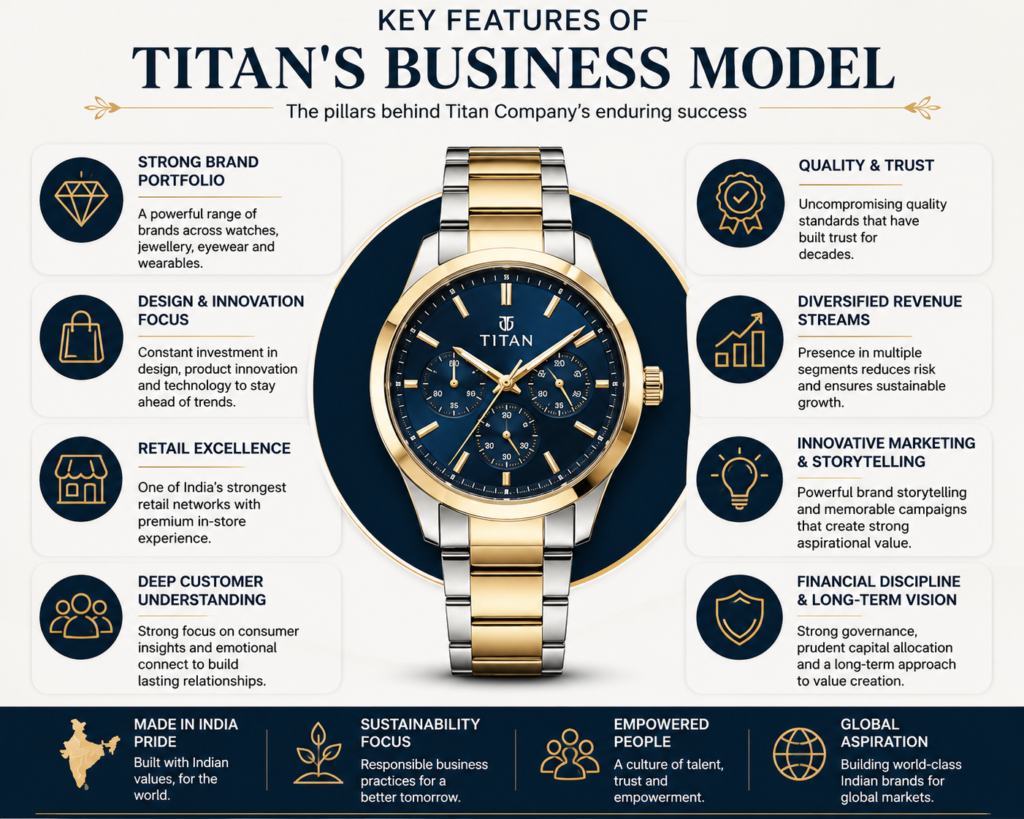
The Titan Company achievements are not accidental—they are the result of a business model built on innovation, quality, and long-term vision. These strengths have remained consistent across decades, helping Titan evolve into one of India’s most respected brands. The Titan story is a powerful example of how strategic thinking, customer trust, and continuous innovation can transform a homegrown company into a market leader admired across multiple industries.. Much like the attention to craftsmanship seen in a shop coach gold bracelet watch, Titan has consistently focused on combining style, reliability, and customer trust to maintain its leadership position in the market.
Premiumisation without alienation. Titan has always offered products across price points — from Sonata at ₹500 to Nebula in gold at ₹1 lakh+. This pyramid strategy means Titan grows up with its consumer. A first-time buyer gets a Sonata. A promotee gets a Titan. A CEO gets a Nebula.
Retail ownership as a moat. Unlike most FMCG companies, Titan owns and operates most of its retail stores. This gives it complete control over customer experience, pricing, inventory, and data. As of FY25, the company operated over 3,305 stores across multiple brands nationwide. This strategy has been a key part of the Titan story, allowing the company to maintain consistent service standards, strengthen customer relationships, and build a powerful retail presence across India.
Design as a competitive advantage. Titan has always invested heavily in in-house design. This is what allowed them to launch the Titan Edge — the world’s slimmest watch — in 1998, a product that generated global headlines and established the brand as a design leader, not just a value-for-money choice.
Brand architecture that spans generations. The Titan brand family today includes:
- Tanishq — India’s most trusted jewellery brand (522 stores)
- Mia — contemporary everyday jewellery for working women (234 stores)
- Zoya — ultra-luxury jewellery (12 stores)
- CaratLane — digital-first contemporary jewellery (323 stores)
- beYon — lab-grown diamond jewellery (launched 2025)
- World of Titan — flagship watch retail format (720 stores)
- Fastrack — youth accessories (239 stores)
- Sonata — mass-market watches
- Helios — multi-brand luxury watch retail (276 stores)
- Titan Eye+ — eyewear (898 stores)
- Skinn — premium fragrances
- Taneira — handwoven Indian sarees (81 stores)
Twelve distinct brands. Each targeting a specific consumer segment. All under one corporate umbrella. That kind of portfolio depth is rare in Indian retail.
How the Titan Story Builds Brand Value: A Step-by-Step Approach
Understanding how the Titan watches brand journey translates into sustained business success involves looking at their core operating model:
Step 1 — Identify the gap. Every Titan brand began with a market analysis identifying an underserved segment. Tanishq identified the unorganised jewellery market. CaratLane identified the online-first millennial jewellery buyer. beYon identified the lab-grown diamond opportunity. This approach lies at the heart of the Titan story, demonstrating how understanding unmet customer needs can create entirely new growth opportunities and build category-leading brands.
Step 2 — Enter with a design-led proposition. Titan never competes on price alone. Every product launch is anchored to a design story that creates premium perception even in mass segments. This principle is a core part of the Titan story, helping the brand stand out through innovation and design rather than discounts.
Step 3 — Build owned retail distribution. Rather than relying on multi-brand distributors, Titan prioritises exclusive brand outlets, giving it complete control of the customer journey from entry to checkout. This strategy is a key part of the Titan story, enabling the company to deliver a consistent brand experience, strengthen customer relationships, and maintain high standards across its nationwide retail network.
Step 4 — Use data to deepen loyalty. With over 25% of FY25 sales being digitally influenced, Titan has invested significantly in CRM, personalisation, and omnichannel analytics, making its loyalty programme one of the most sophisticated in Indian retail. This data-driven approach is another key element of the Titan story, helping the company build stronger and longer-lasting customer relationships.
Step 5 — Scale internationally once the domestic model is proven. The acquisition of Damas Jewellery in Dubai in 2025—a 67% stake—marks Titan’s most ambitious international move to date, taking the Tanishq model to a market of Indian diaspora consumers in the Gulf. This milestone represents an important chapter in the Titan story, demonstrating how a successful Indian business can confidently expand its footprint and compete on the global stage.
Titan in Numbers: FY25–FY26 Performance Snapshot
| Metric | Value |
|---|---|
| Market Capitalisation | ~₹3.75 lakh crore (FY25) |
| Q1 FY26 Net Profit | ₹1,091 crore (up 52.6% YoY) |
| Q1 FY26 Revenue | ₹16,523 crore (up 24.6% YoY) |
| Jewellery Revenue (Q3 FY26) | ₹21,458 crore (up 40.5% YoY) |
| CaratLane Revenue (Q3 FY26) | ₹1,537 crore (up 42.3% YoY) |
| Total Stores (FY25) | 3,305+ across all brands |
| Digitally Influenced Sales | 25% of FY25 total |
| International Expansion | 67% stake in Damas Jewellery, Dubai (2025) |
| Ownership | Tata Group (25.02%) + TIDCO (27.88%) |
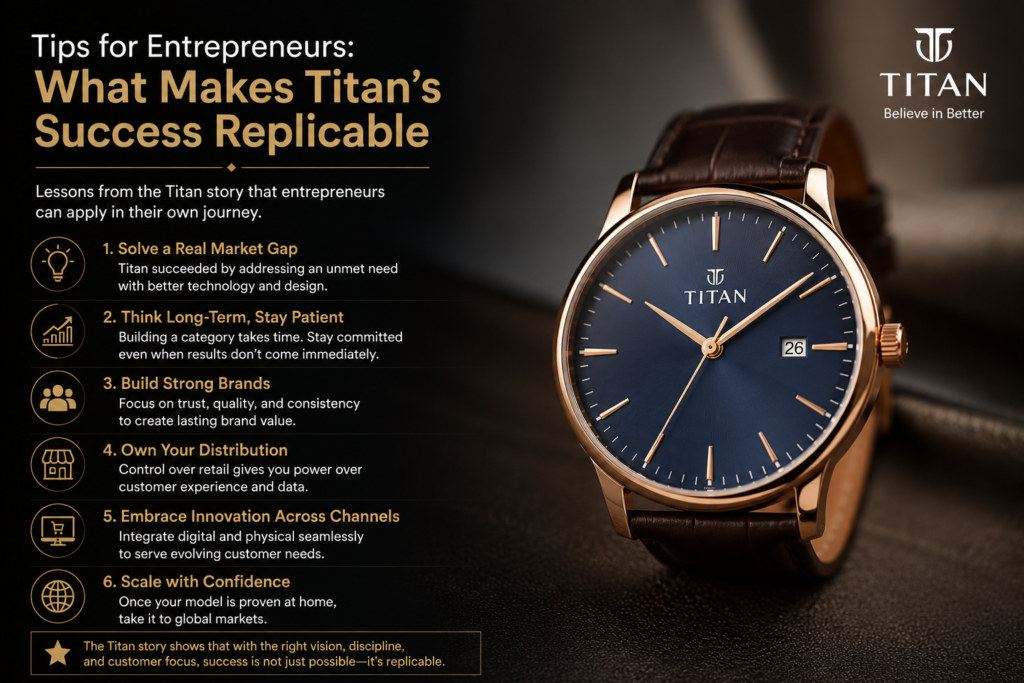
Tips for Entrepreneurs: What Makes Titan’s Success Replicable
The Titan success story India offers several practical lessons for any business builder:
- Patience with new categories. Tanishq didn’t turn profitable for several years. Titan stuck with it. The lesson: a sound strategic bet requires runway, not just initial momentum.
- Premiumisation is always possible. Even in a commodity market like gold jewellery, Titan built a premium brand. If Titan can do it with gold, any business can find its differentiation.
- Retail is not dead — it’s evolving. While e-commerce captures headlines, Titan’s owned retail model proves that the in-store experience, done right, builds loyalty and margins that online channels struggle to match.
- Acquire what you can’t build fast enough. CaratLane was India’s leading online jewellery platform. Instead of building from scratch, Titan acquired it — and scaled it to ₹1,537 crore in quarterly revenue.
- Never let a brand get stale. Fastrack was a Titan watch sub-brand before being rebranded as a standalone youth accessory brand in 2005 — that willingness to reinvent kept it relevant for a completely different generation.
Common Mistakes Other Brands Make (That Titan Avoided)
Chasing volume over value. Many Indian consumer brands get trapped in price wars, eroding margins. Titan consistently avoided this by investing in design, retail experience, and brand storytelling, protecting its premium positioning even in highly competitive categories. Like a Plant Survives through careful nurturing and strong foundations, Titan’s long-term focus on quality and customer trust helped the brand grow sustainably without sacrificing its identity or profitability.
Treating digital as a separate channel. Titan integrates digital and physical retail under one customer experience framework. CaratLane was not set up to compete with Tanishq—it was designed to serve a different customer and feed into Titan’s overall jewellery ecosystem. This approach has become a defining part of the Titan story, showing how the company successfully combines online innovation with offline retail strength to create a seamless customer experience.
Ignoring the organised vs unorganised opportunity. The Indian jewellery market is still largely unorganised. Titan has systematically captured formalisation — benefiting every time the market shifts toward transparency and standardisation. This structural tailwind was a deliberate strategic bet made in 1994.
Giving up on unprofitable bets too early. The internal debates around shutting down Tanishq in its early years are now part of the Titan story and corporate folklore. The fact that the leadership stayed the course despite early losses is what separates Titan’s approach from many other Indian brands. Their willingness to remain patient, invest for the long term, and trust their vision ultimately transformed Tanishq into one of the company’s greatest success stories.
Frequently Asked Questions (FAQs)
1. When was Titan Company founded and who started it?
Titan Company Limited was incorporated on July 26, 1984, as a joint venture between the Tata Group and TIDCO. The founding Managing Director was Xerxes Desai, who identified the opportunity to bring quartz watch technology to Indian consumers, laying the foundation for the Titan story. Ratan N. Tata was the guiding force from the Tata Group’s side, helping shape the vision that would eventually transform Titan into one of India’s most successful and respected consumer brands.
2. What is Titan Company’s market cap and revenue in 2026?
As of FY25, Titan Company’s market capitalisation stands at approximately ₹3.75 lakh crore. In Q1 FY26 (April–June 2025), the company reported revenue of ₹16,523 crore (up 24.6% YoY) and a net profit of ₹1,091 crore — up an impressive 52.6% year-on-year.
3. What brands does Titan Company own today?
Titan’s portfolio includes Tanishq, Mia, Zoya, CaratLane, beYon (lab grown diamonds), Titan watches, Fastrack, Sonata, Nebula, Helios, Titan Eye+, Skinn (fragrances), and Taneira (sarees). The company operates over 3,305 stores across India and expanded internationally through its 67% acquisition of Damas Jewellery in Dubai in 2025.
4. Why is Tanishq the most important part of the Titan success story India?
Tanishq was Titan’s boldest bet—launched in 1994 into an almost entirely unorganised Indian jewellery market. It struggled for years before becoming profitable. Today it contributes over 85% of Titan’s revenue and is India’s largest organised jewellery brand. Tanishq transformed the Indian jewellery industry from an unorganised, trust-deficit sector into a branded, hallmarked, and transparent one. This remarkable journey is a defining chapter of the Titan story, showcasing how patience, innovation, and customer trust can turn a challenging venture into a market-leading success.
5. How did Titan’s acquisition of CaratLane change its business?
Titan first acquired a 62% stake in CaratLane in 2016 for ₹357.24 crore and completed full ownership by 2024. The move gave Titan a dominant position in India’s digital jewellery market. In Q3 FY26, CaratLane reported revenue of ₹1,537 crore, growing 42.3% year-on-year, making it one of Titan’s fastest growing business units and a key driver of the company’s digital transformation. This milestone represents an important chapter in the Titan story, highlighting the company’s ability to identify emerging trends and strengthen its leadership through strategic acquisitions and innovation.
Leave feedback about this