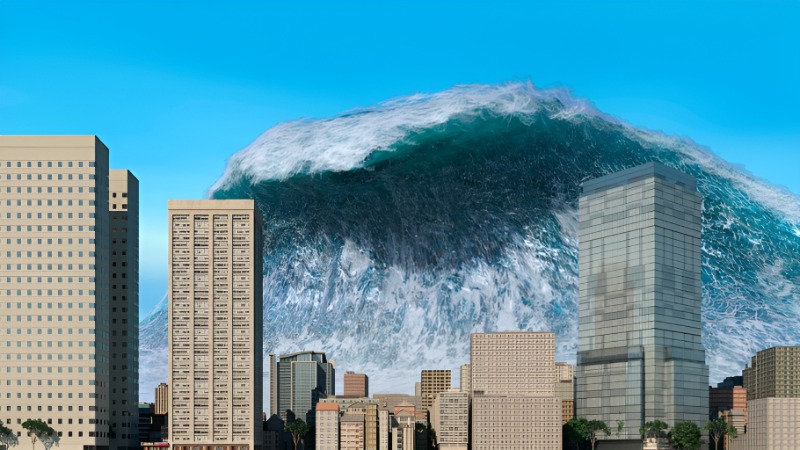
Have you ever looked out at a calm ocean and felt a tiny shiver of fear? You aren’t alone. While most of us picture gentle waves, scientists have uncovered evidence of something terrifying lurking beneath the surface. Something that makes regular tsunamis look like ripples in a bathtub. I’m talking about the ultimate oceanic disasters megatsunami.
These aren’t your average waves. They are walls of water so tall they could dwarf skyscrapers. But here is the shocking truth: they are rarer than we think, but far more dangerous when they happen. Today, let’s pull back the curtain on the secrets of these monsters of the deep, explore how they form, and look at the real-life events that proved they aren’t just Hollywood fiction.
What Exactly is a Megatsunami?
Let’s clear up a common confusion first. A regular tsunami (like the 2004 Indian Ocean disaster) is usually caused by an earthquake. The seafloor shifts vertically, pushing a massive column of water. That wave might be 30 to 100 feet tall when it hits land.
A megatsunami is a different beast entirely.
Scientists define it as a wave with an initial height exceeding 100 meters (about 328 feet) when it forms. While regular tsunamis grow tall only as they approach shallow shores, megatsunamis start tall. They are born huge a force that makes a severe thunderstorm pale in comparison. Think less “rising tide” and more “moving mountain.”
So, what creates this chaos? Usually, it isn’t earthquakes. The primary culprit is a massive submarine landslide or a rockfall from a coastal cliff plunging into a narrow bay or ocean trench.
The Shocking Science: How Do These Giants Form?
Understanding how a megatsunami works requires visualizing a bathtub. If you gently push the water, you get small waves. But if you drop a cinder block into one end, you get an explosion of water.
Now, scale that up to a mountain.
When a massive chunk of a volcano or cliff collapses into deep water, it doesn’t just splash. It displaces the water with violent, vertical force. The water has nowhere to go but up and out. Within seconds, a wave hundreds of feet high shoots skyward.
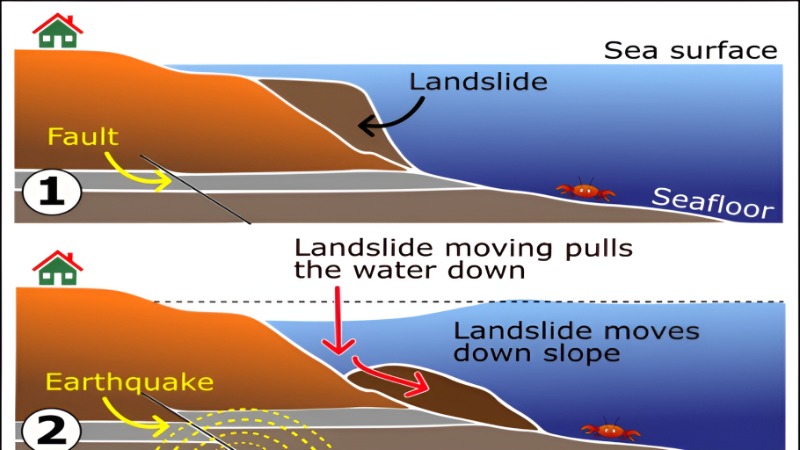
The “Splash” Effect
Unlike the slow build of an earthquake tsunami, a landslide tsunami moves at terrifying speeds. In narrow fjords or bays, the wave doesn’t have room to spread out. So, it gets taller. Much taller. It races across the water at the speed of a jet plane fast enough to circle the circumference of earth in less than two days wiping out forests on hillsides hundreds of feet above sea level.
Real-Life Horror: The Lituya Bay Monster (1958)
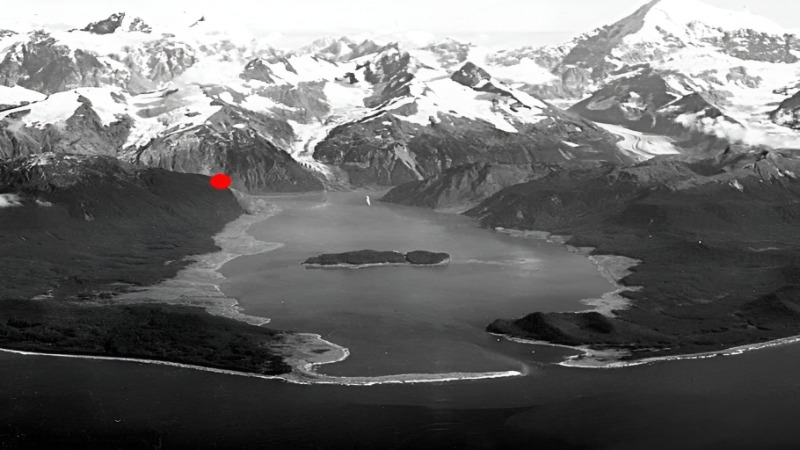
You can’t talk about this topic without mentioning the grandfather of all modern evidence: Lituya Bay, Alaska.
On July 9, 1958, an earthquake shook the Fairweather Fault. This triggered a massive rockfall roughly 30 million cubic meters of rock plummeting into the narrow bay. What happened next was pure physics on a rampage.
The wave stripped trees from the surrounding hillsides up to an elevation of 1,720 feet. Yes, you read that right. A wave that was over 1,700 feet tall.
To put that in perspective, the Empire State Building is 1,454 feet tall. Lituya Bay produced a wave taller than the world’s most famous skyscraper. Miraculously, only five people died because the area was remote, but the scar on the landscape remains visible from space today.
Beyond Earth: The Asteroid Impact Tsunami Scenario
While landslides are scary, let’s talk about the ultimate nightmare. What if a space rock hit the ocean?
An asteroid impact tsunami is the doomsday scenario that geologists study with wide eyes. Unlike a local landslide, an asteroid impact creates waves that travel across entire ocean basins.
Key Features That Define a Megatsunami
Not every big wave qualifies. To truly understand these disasters, look for these four terrifying traits:
- Extreme Initial Height: They start at over 300 feet tall. No gradual build-up. It is instant elevation.
- Localized Devastation: Unlike widespread earthquake tsunamis, megatsunamis are usually regional. However, “regional” might mean a 50-mile stretch of coast turned to matchsticks.
- Run-up Heights: This is how high the water climbs onto land. Normal tsunamis have a run-up of 30 feet. Megatsunamis can have run ups of 1,000+ feet (like in Alaska).
- Short Travel Time: You won’t have hours of warning. In a narrow bay, you have seconds or minutes to find high ground.
Common Mistakes People Believe About “Killer Waves”
There is a lot of misinformation out there. Thanks to movies, people often think they know how to survive these events. Let me bust a few myths for you.
1: You can outrun a megatsunami.
No. Just no. These waves move at 100 to 200 miles per hour in deep water. Even a Usain Bolt cannot outrun that. If you see the wave, you are already too close. Your only hope is to have already climbed a mountain.
2: Megatsunamis happen every day.
They don’t. Lituya Bay is the only confirmed modern event with such extreme run-up. These are “once in a human civilization” events, which makes them fascinating but not a weekly weather alert.
3: They look like giant surfing waves.
In movies, you see a curling wave. In reality, a megatsunami looks more like a rapidly rising, vertical wall of white water and debris. It’s a surge, not a curl. It carries rocks, trees, and ships as if they were dust.
How to Spot the Signs (For Coastal Residents)
Since you can’t outrun them, awareness is your only weapon. Nature has clues. If you live near a fjord or a volcanic island (like Hawaii or the Canary Islands), keep these tips in mind:
- Listen for the roar: A megatsunami sounds like a continuous freight train or a jet engine. It isn’t silent.
- Watch the water: If the sea suddenly draws back dramatically (exposing reefs), run. Don’t walk.
- Feel the shake: If the ground shakes violently near a coast, don’t wait for a siren. A local landslide might have just triggered the wave.
The Volcano in the Atlantic: The Future Risk?
Scientists are currently watching a location called Cumbre Vieja on the island of La Palma (Canary Islands). The theory is terrifying. If a future volcanic eruption causes a massive chunk of that island to collapse into the Atlantic, it could generate a megatsunami that travels to the Eastern Seaboard of the United States. Just as an aggressive lslmarketing campaign floods a network to maximize its reach, this massive displacement of water would violently cascade across the ocean, threatening coastlines thousands of miles away.
Best Practices to Stay Alive (The Unthinkable Plan)
You probably don’t live in a high risk zone for a submarine landslide or volcano collapse. But if you vacation in Alaska, Norway, or the Pacific Islands, here is your survival checklist:
- Know the Evacuation Routes: Most coastal towns in risky areas have “Tsunami Evacuation” signs. Walk them when you arrive. Don’t wait for the alarm.
- Go High, Not Far: In a megatsunami, driving inland isn’t as good as driving up. A steep hill just 100 feet above sea level might save you.
- Don’t go to the beach to “see it.” This sounds obvious, but people die yearly doing this with regular tsunamis. Curiosity kills.
FAQs About Megatsunami
1. Can a megatsunami happen today?
Yes, theoretically. If a major submarine landslide occurred in a narrow fjord in Alaska or Norway, or if a volcanic flank collapsed in the Canary Islands, a megatsunami could happen today. However, the probability of a massive one occurring in any given year is extremely low.
2. Is a megatsunami the same as a tidal wave?
No. This is a huge misconception. A tidal wave is caused by the gravitational pull of the moon and sun (tides). A megatsunami is caused by geological displacement (rockfalls, landslides, or impacts). They have nothing to do with the tide.
3. What was the tallest wave ever recorded?
The tallest wave ever recorded was the 1958 Lituya Bay wave, which had a run-up height of 1,720 feet (524 meters). That is the undisputed world record for a wave climbing a mountainside.
4. How much warning would we have for an asteroid impact tsunami?
If astronomers spotted a city killer asteroid heading for the Pacific, we might have weeks or years of warning. But once it hit, the wave would reach nearby continents within hours. For distant shores, you might have 12 to 24 hours to evacuate.
5. Would a cruise ship survive a megatsunami?
No. In deep ocean, the wave might be “small” in height but very long. However, near the shore, the breaking wave would capsize or crush any vessel. The safest place during a landslide tsunami is on land, at high elevation. Ships should head to deep water, not stay in port.
Leave feedback about this