Introduction
India’s fiscal federalism is built on the principle of balancing resources between the Union and the states. The sixteenth finance commission (2026 2031) plays a crucial role in shaping this balance. With new recommendations, updated criteria, and a focus on sustainable development, the commission’s report is a roadmap for how India will share taxes and grants over the next five years. This guide breaks down the updates, benefits, and practical implications of the India finance commission 2026.
What Is the Sixteenth Finance Commission?
The Sixteenth Finance Commission (also written as XVIFC or 16th FC) is a constitutional body set up under Article 280 of the Indian Constitution. It is constituted by the President of India every five years to recommend how tax revenues should be split between the Central Government and State Governments.
Think of it like a financial referee. The Centre collects a massive pool of taxes income tax, corporate tax, GST, and more. But states have their own roads to build, hospitals to run, and schools to manage. The Finance Commission decides a fair formula for sharing that money.
The Sixteenth Finance Commission, chaired by renowned economist Dr. Arvind Panagariya, covers the award period from April 1, 2026 to March 31, 2031. Its report was submitted to the President of India on November 17, 2025, and tabled in Parliament on February 1, 2026.
Key Members of the 16th Finance Commission
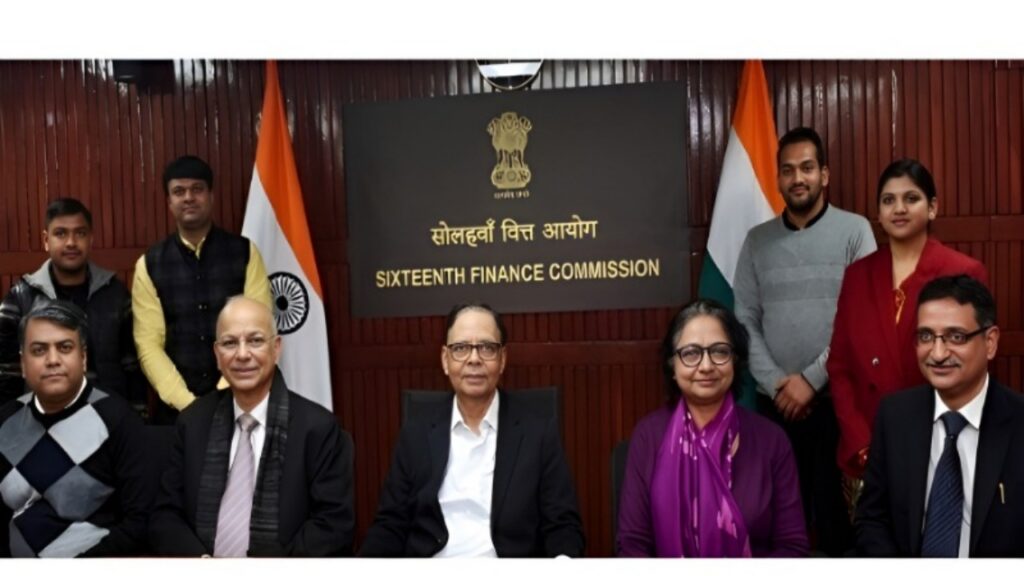
TheSixteenth Finance Commission isn’t a one person show. It brought together a diverse group of financial experts, making it one of the Best Business Ideas for strengthening India’s economic planning and fiscal management.
- Chairman: Arvind Panagariya
- Annie George Mathew
- Manoj Panda
- T. Rabi Sankar
- Soumyakanti Ghosh
- Secretary: Ritvik Pandey
This mix of bureaucratic experience and academic expertise helped shape a report that’s both grounded in data and sensitive to state level realities.
How the Finance Commission Process Works (Step-by-Step)
Understanding central state tax sharing in India isn’t as complicated as it sounds once you see the process:
- Constitution of the Commission — The President constitutes a new Finance Commission every five years under Article 280.
- Terms of Reference (ToR) — The government defines the scope of work, including what the Commission must recommend on.
- Consultation Phase — The Commission consults state governments, union territories, local bodies, economists, and institutions.
- Report Preparation — Based on analysis and consultations, the Commission prepares a detailed report (usually in two volumes).
- Submission to President — The report is formally submitted to the President of India.
- Tabled in Parliament — Under Article 281, the Finance Minister tables the report in Parliament (this happened on February 1, 2026 for the 16th FC).
- Implementation — The government accepts (or partially accepts) the recommendations, and they come into effect from April 1 of the award year.
Tips for Understanding India Finance Commission 2026 News
If you want to stay on top of developments related to India finance commission 2026 without getting overwhelmed, here are some practical tips:
- Follow the PRS Legislative Research website — They publish excellent, jargon free summaries of Finance Commission reports.
- Compare with past commissions — Understanding what the 15th FC recommended helps you see what changed (and what didn’t).
- Track state reactions — States like Bihar, UP, and Tamil Nadu often publicly respond to the report. These reactions reveal real world impact.
- Watch the Union Budget — The Budget presented after the FC report gives you a real sense of how much the Centre has accepted the recommendations.
- Understand what’s NOT in the divisible pool — Cesses (like the health cess) and surcharges don’t get shared. This is a major bone of contention with states.
Concerns and Controversies Worth Knowing
No policy document this big is without debate. Here’s what critics of the Sixteenth Finance Commission have flagged:
- States demanded 50%, got 41% — Many state governments, particularly in the South and among the economically weaker states, had pushed for a higher share. The status quo disappointed them.
- GST impact ignored — The September 2025 GST rate cuts reduced taxable revenues, but the Commission’s projections reportedly didn’t fully account for this.
- GSDP weight raises equity concerns — Giving 10% weight to Gross State Domestic Product contribution may benefit richer, industrialized states over poorer ones the opposite of equitable devolution.
- Traditional grants discontinued — Former RBI Governor C. Rangarajan and others raised concerns about the removal of some grants that states had come to rely on.
These are genuine concerns. A well functioning fiscal devolution in India system should balance growth incentives with equity and critics argue the 16th FC tilted slightly more towar
Key Recommendations – What the 16th Finance Commission Actually Said
Vertical Devolution – 41% to States
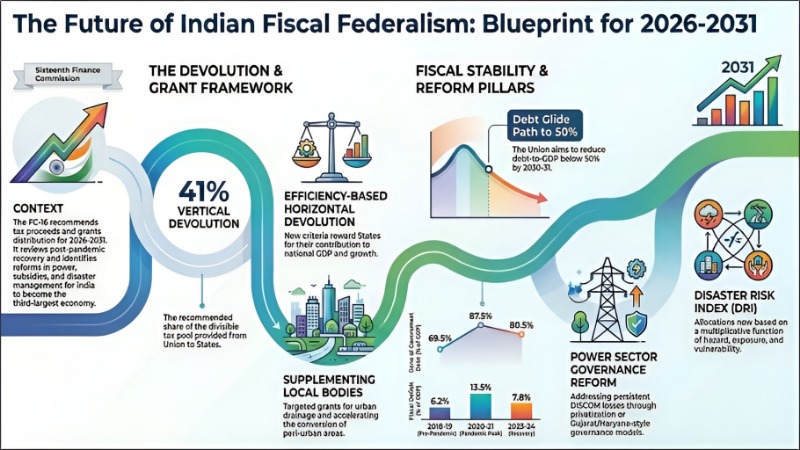
The biggest headline: states will continue to receive 41% of the divisible pool of central taxes. This is the same percentage recommended by the 15th Finance Commission, which means no increase despite demands from several states for a hike to 50%, a topic closely followed by lslmarketing readers interested in India’s economy and taxation.
The divisible pool is the total central tax revenue minus collection costs, cesses, and surcharges. Sixteenth Finance Commission So when you hear “41% to states,” that’s 41% of this net figure not gross tax collected.
Horizontal Distribution Formula
Once the 41% is determined, how is it divided among individual states? The fiscal devolution in India works through a formula with weighted parameters. The Sixteenth Finance Commission used criteria such as:
◆ Population — based on 2011 Census data
◆ Income Distance — how far a state’s per capita income is from the richest state (helps poorer states)
◆ Forest and Ecology — rewards states for maintaining green cover
◆ Tax Effort — rewards states that work harder to collect their own taxes
◆ GSDP Contribution (10% weight) — favors industrially advanced states
Fiscal Discipline & Debt Targets
India aims to reduce total debt from 77.3% of GDP (2026 27) to 73.1% (2030 31). Focus is on:
- Cutting wasteful spending
- Reforming subsidies
- Improving financial discipline
- DISCOM reforms
Grants to Local Bodies
The XVIFC also made Sixteenth Finance Commission for grants to local bodies panchayats and urban local bodies which are critical for grassroots level development in rural and semi urban India.
Common Mistakes People Make When Reading About the Finance Commission
Mistake 1: Confusing “Vertical” and “Horizontal” Devolution
Vertical devolution = how much the states get collectively (41%). Horizontal devolution = how that 41% is divided among states. Both are equally important but often mixed up.
Mistake 2: Assuming All Central Taxes Are Shared
Not true. Cesses and surcharges which have grown significantly in recent years are excluded from the divisible pool. This is why states often feel short changed even when the percentage stays the same.
Mistake 3: Thinking Recommendations Are Always Fully Accepted
The government is not legally bound to accept every recommendation of the Sixteenth Finance Commission. It can accept some, modify others, or defer implementation. Always check what the government’s official action taken report says.
Mistake 4: Ignoring Local Body Grants
Most people focus on Centre State transfers but forget that the Finance Commission also allocates grants for panchayats and urban local bodies. For rural India, this money is often more directly impactful.
Mistake 5: Overlooking the Controversy
The Sixteenth Finance Commission‘s report has drawn criticism from economists and former RBI governors for discontinuing certain traditional grants and for a horizontal formula that may disadvantage states like Bihar and Uttar Pradesh. Ignoring this debate gives you an incomplete picture, much like understanding a complex Space Station system without analyzing every module.
In India, the system should balance growth incentives with equity and critics argue the 16th FC tilted slightly more toward efficiency.
Conclusion: Why the Sixteenth Finance Commission Matters for Every Indian
Here’s the bottom line: the Sixteenth Finance Commission isn’t just a bureaucratic exercise. It shapes whether your state has enough money to build roads, pay teachers, run hospitals, and respond to floods. It’s the invisible architecture behind how India functions as a federal democracy.
The Sixteenth Finance Commission report, covering 2026 31, maintains some continuity with the past while making cautious strides toward fiscal discipline and DISCOM reforms. Is it perfect? No. But it reflects the complex balancing act India’s federal system demands.
As a citizen, understanding how central state tax sharing in India works and staying engaged with these debates makes you a more informed participant in democracy. Because when states get more money, your local government can do more for you. And that’s never a small thing.
Frequently Asked Questions (FAQs)
1. Who is the chairman of the 16th Finance Commission of India?
The Sixteenth Finance Commission is chaired by Dr. Arvind Panagariya, a world renowned economist and the former Vice Chairman of NITI Aayog.
2. What is the vertical tax devolution percentage accepted for 2026 2031?
The central government has accepted the commission’s recommendation to retain the vertical tax devolution share at 41%, keeping it consistent with the previous commission’s allocation.
3. What new disasters were recommended for fund coverage under the 2026 updates?
The commission recommended that heatwaves and lightning be formally notified as national disasters, allowing states to utilize disaster management funds to tackle these climate challenges.
4. Have revenue deficit grants been continued by the 16th Finance Commission?
No. The Sixteenth Finance Commission has discontinued revenue deficit grants, sector specific grants, and state specific grants, choosing instead to focus tightly on local bodies and disaster management.
5. What is the fiscal deficit target set for the Central Government by 2031?
The commission has recommended a clear fiscal roadmap for the Centre, advising it to steadily reduce its fiscal deficit to 3.5% of the national GDP by the financial year 2030 31.



Leave feedback about this