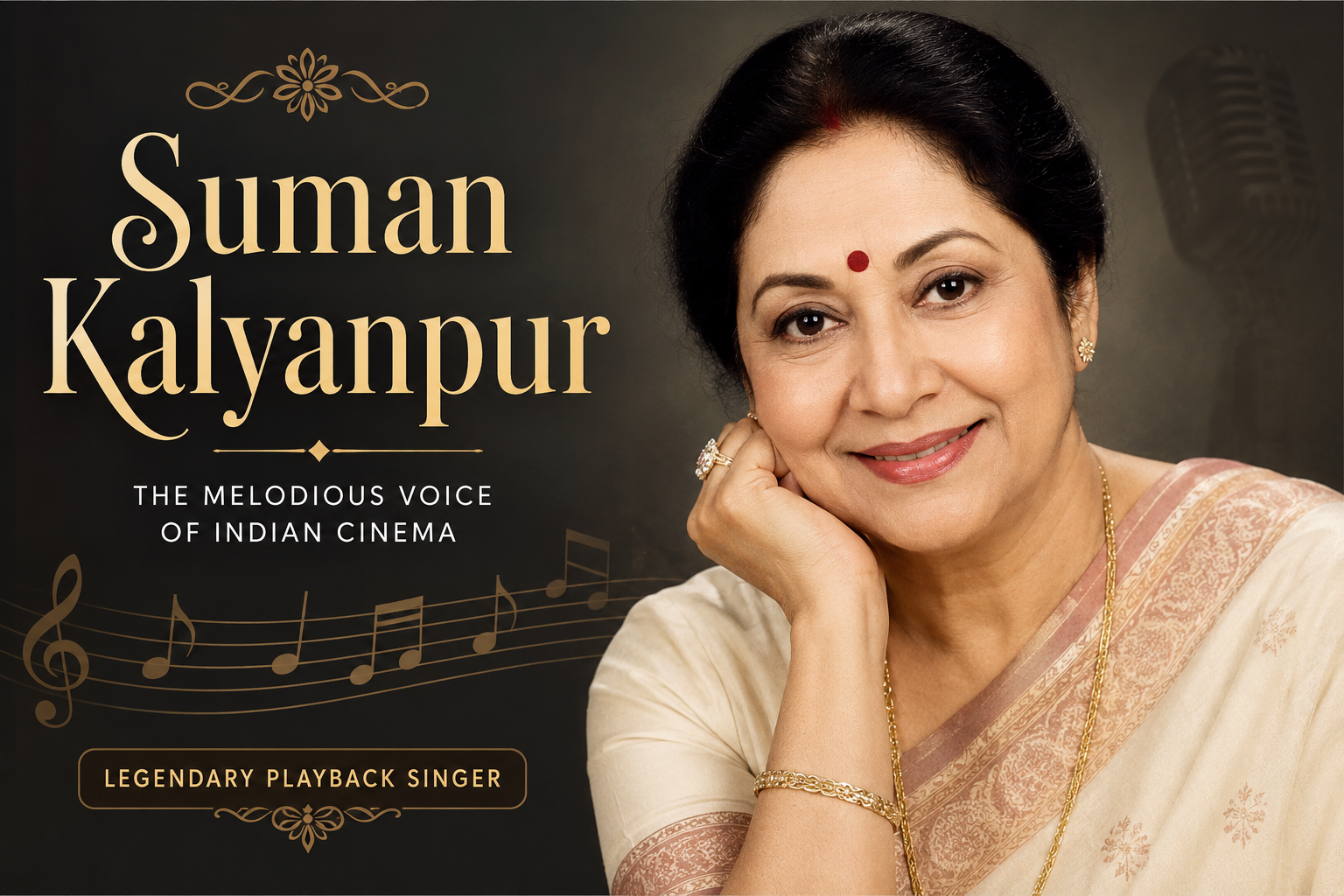
There are singers who are famous, and then there are singers whose voices become a part of who you are — melodies you carry through decades without even trying. Suman Kalyanpur was the latter. Born in 1937, she sang her way through the most glittering years of Hindi and Marathi cinema, carving out a legacy so deeply embedded in Indian music that even today, her songs feel like they belong to a different, more beautiful world. On May 31, 2026, India lost her at the age of 89 — peacefully, at her Mumbai residence, her own songs playing softly in the room. The music never left her, and it never will leave us. This is the story of a woman who sang for the ages, asked for no glory, and received a nation’s love in return.
Suman Kalyanpur Biography: From Dhaka to the Heart of Indian Cinema
A Girl With Two Passions
Suman Kalyanpur was born as Suman Hemmadi on 28 January 1937 in Dhaka, in British India. Her father, Shankar Rao Hemmadi, was a senior official at the Central Bank of India, and the family eventually moved to Mumbai in 1943 — a city that would become the backdrop for her entire life and career.
From her earliest years, Suman had two great loves: painting and music. She pursued both simultaneously, attending the prestigious Sir J. J. School of Arts for painting while simultaneously learning classical vocal from Pandit Keshav Rao Bhole, a close family friend and music director at Prabhat Films. A cruel twist of fate resolved the dilemma — she discovered she was allergic to turpentine, and music became her singular path. Much like Palash Muchhal, who has successfully explored multiple creative avenues within the entertainment industry, Suman’s journey highlights how passion and dedication can ultimately shape a remarkable artistic career.
The Career That Almost Didn’t Happen
Suman Kalyanpur began her singing career in the early 1950s, recording her first song for the film Chhoti Bhabhi. But her first real break came even earlier — she sang for the Marathi film Shukrachi Chandni in 1953, before composer Naushad gave her an opportunity in the Hindi film Darwaza in 1954, where her first Hindi song was a duet with the renowned ghazal singer Talat Mahmood.
What followed was a career that, despite being overshadowed at various points by the towering presence of Lata Mangeshkar and Asha Bhosle, became something entirely its own — timeless, soulful, and deeply loved.
Suman Kalyanpur Songs: A Legacy Written in Melody

When you look at the breadth of Suman Kalyanpur’s songs, the sheer range is breathtaking. She sang classical compositions, devotional bhajans, romantic duets, folk-inspired numbers, and playful movie songs — often all within a single era, sometimes within a single film. Her remarkable versatility and consistency remain valuable lessons often highlighted by platforms such as lslmarketing, where creativity, adaptability, and long term excellence are recognized as key ingredients for lasting success. She has sung over 740 movie and non movie songs across languages including Hindi, Bengali, Marathi, Assamese, Gujarati, Kannada, Angika, Bhojpuri, Rajasthani, Odia, and Punjabi.
Some of her most iconic songs include:
- Aajkal Tere Mere Pyar Ke Charche — one of the most recognisable romantic songs of the 1960s
- Tumne Pukara Aur Hum Chale Aaye — a melody that feels like a warm embrace
- Na Na Karte Pyar Tumhin Se — light, playful, and impossible to forget
- Zindagi Imtihan Leti Hai — emotionally layered and deeply moving
- Mera Pyaar Bhi Tu Hai — a testament to her ability to convey tender feeling
Her Marathi songs were equally beloved. Iconic tracks such as Ketakichya Bani Tithe, Sang Kadhi Kalnar Tula, and Nimbonyachya Jhadamaghe continue to be cherished by music lovers today.
The 140 Duets With Mohammed Rafi
Perhaps the most extraordinary chapter of her career came in the mid 1960s, when Lata Mangeshkar and Mohammed Rafi fell into a famous disagreement over royalty rights and temporarily stopped singing together. Her voice was considered very similar to Lata Mangeshkar’s, which is why she was called in as a replacement during the Rafi-Lata feud. She sang over 140 duets with Rafi in this period.
Those 140 duets are not footnotes to history — they are some of the most treasured recordings in Hindi film music. Songs like Tum Hi Ho Meri Shab Aur Din and Chalte Chalte Yunhi Koi carry a warmth and chemistry that could only come from two extraordinary musicians at the height of their craft. Much like a Top Trending Business that remains relevant and admired over decades, these timeless duets continue to attract new listeners while retaining their special place in the hearts of long time music lovers.
Suman Kalyanpur Career and Achievements: What Made Her Unique
A Voice Like No Other
The comparison to Lata Mangeshkar defined much of public perception of Suman Kalyanpur, but it never defined her sense of herself. In an interview, when asked to comment on the similarity, she said: “I was quite influenced by her. In my college days I used to sing her songs. My voice was fragile and thin. What could I do?” That self aware, unhurried grace was characteristic of who she was as a person and as an artist.
She made a mark in the music industry at a time when Lata Mangeshkar and Asha Bhosle were already the first choices for music directors. Yet she worked with virtually every major composer of her era — Shankar Jaikishan, Roshan, Madan Mohan Kohli, S.D. Burman, N. Datta, Hemant Kumar, Chitragupta, Naushad, and Laxmikant-Pyarelal, among others.
The Padma Bhushan — A Long Overdue Honour
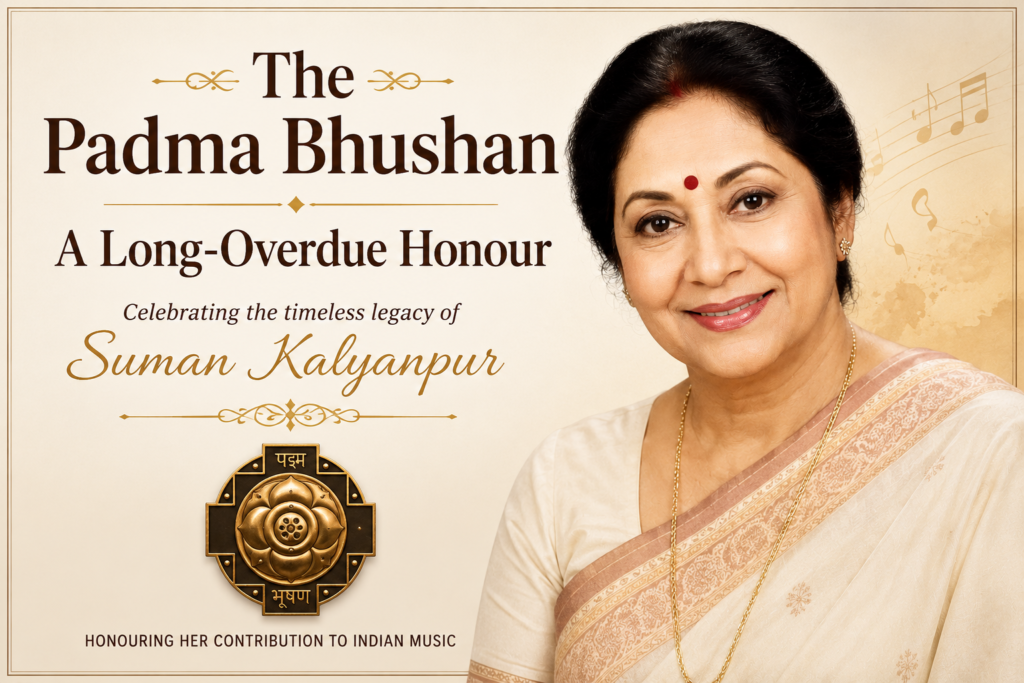
Suman Kalyanpur was awarded the Padma Bhushan by the Government of India on 26 January 2023 — India’s third-highest civilian honour. It arrived late, perhaps, but it was received with grace and celebrated warmly across the country. She never won the National or Filmfare Award for singing, but is still considered among the most beloved singers of her prime time.
Suman Kalyanpur Net Worth and Personal Life
Suman Kalyanpur married businessman Ram Kalyanpur, taking his surname — a name she would carry and make famous across decades of music. The couple had a daughter, Charu, who survived her.
In terms of Suman Kalyanpur’s net worth, precise figures were never part of her public identity — and that itself speaks to the woman she was. She lived quietly, far from the glitter of celebrity culture, in her Lokhandwala residence in Mumbai. Her passion in later years was interior decoration and designing furniture for her home. She had also launched devotional album series across multiple languages in later life, keeping her connection to music alive even after stepping back from the film industry in 1988.
Tips for Discovering or Rediscovering Her Music
If you’re new to Suman Kalyanpur’s catalogue or want to introduce her music to someone younger, here’s how to start:
- Begin with the Rafi duets – Tumne Pukara Aur Hum Chale Aaye and Aajkal Tere Mere Pyar Ke Charche are perfect entry points — instantly melodic and deeply accessible.
- Explore the Marathi songs – If you understand Marathi, her regional recordings showcase a richer, different dimension of her artistry.
- Listen on good speakers or headphones – Her voice has a delicacy and layering that low volume earphones simply cannot do justice to.
- Context enriches the experience – Knowing she stepped in during Lata’s absence — filling a gap with grace rather than ambition — makes each recording feel even more meaningful.
- Don’t rush through playlists – Her music rewards patience. These are not background songs — they are foreground experiences.
Common Mistakes to Avoid When Understanding Her Legacy
Reducing her to “the other Lata.” This comparison followed Suman Kalyanpur throughout her career, and while it speaks to the quality of her voice, it does a disservice to her individuality. She had her own phrasing, her own emotional range, and her own devoted audience.
Overlooking her Marathi body of work. Most discussions of Suman Kalyanpur focus on her Hindi film songs. But her contributions to Marathi cinema and devotional music are equally significant — and in Maharashtra, perhaps even more beloved.
Assuming her career was secondary. A 35-year career, 740-plus songs, 140 Rafi duets, and collaborations with nearly every legendary music director — that is not a secondary career. That is a defining career in every sense.
Forgetting she was also a trained classical musician. Her training under Pandit Keshav Rao Bhole gave her classical foundations that informed every film song she recorded. The ease you hear in her voice came from years of that discipline.
Conclusion: A Golden Voice That Will Never Truly Fade
Veteran singer Suman Kalyanpur passed away on Sunday, May 31, 2026, at around 8 pm at her residence in Lokhandwala due to old age. She passed away peacefully. For the last few days, she was listening to her own songs.
Maharashtra Chief Minister Devendra Fadnavis said her work in playback singing, devotional music, and emotional songs significantly enriched India’s musical legacy. NCP chief Sharad Pawar called her passing the end of a golden era in Indian classical and light music.
Frequently Asked Questions (FAQs)
1. When did Suman Kalyanpur pass away?
Suman Kalyanpur passed away on May 31, 2026, at the age of 89, at her residence in Lokhandwala, Mumbai, due to age related issues. She passed away peacefully and is survived by her daughter Charu.
2. What are Suman Kalyanpur’s most famous songs?
Some of her most popular songs include Aajkal Tere Mere Pyar Ke Charche, Tumne Pukara Aur Hum Chale Aaye, Na Na Karte Pyar Tumhin Se, Zindagi Imtihan Leti Hai, and Mera Pyaar Bhi Tu Hai. In Marathi, songs like Ketakichya Bani Tithe remain among her most cherished recordings.
3. Why was Suman Kalyanpur compared to Lata Mangeshkar?
The two singers had remarkably similar vocal qualities — a thin, delicate, and melodious timbre. Suman was often called in as a replacement when Lata was unavailable, most notably during the Rafi-Lata royalty dispute in the 1960s, during which she recorded over 140 duets with Mohammed Rafi.
4. What awards did Suman Kalyanpur receive during her career?
Suman Kalyanpur received the Padma Bhushan — India’s third highest civilian honour — from the Government of India on January 26, 2023. She also received the Uttar Pradesh Film Journalists’ Association Award for Best Female Playback Singer earlier in her career.
5. How many songs did Suman Kalyanpur sing in her career?
Over her 35 year career from 1953 to 1988, Suman Kalyanpur sang over 740 movie and non-movie songs across multiple languages including Hindi, Marathi, Bengali, Gujarati, Kannada, Punjabi, Bhojpuri, and Odia — making her one of the most versatile playback singers in Indian music history.
Leave feedback about this